by
Hannah Farber
| Aug 26, 2026
The Boelte family farm in Lone Wolf, Oklahoma has been in the family for over a hundred years. It has had Angus on it for most of that time. What it did not have, until three years ago, was a registered Texas Longhorn.
Hunter and Jordan Boelte changed that, with some encouragement from a friend who called at the right moment, at a sale where the market happened to be down.
They did not know then that over seven million Longhorns had been driven through that exact stretch of southwest Oklahoma between 1874 and 1893, right along the path of the Great Western Cattle Trail. There is a stone monument about ten miles from the property marking where the trail came through. Jordan found out about the Longhorn connection after they were already in it.
"One of those discoveries once you're in it," she says. "You dive deep and it's like, here we are."
The Land Itself
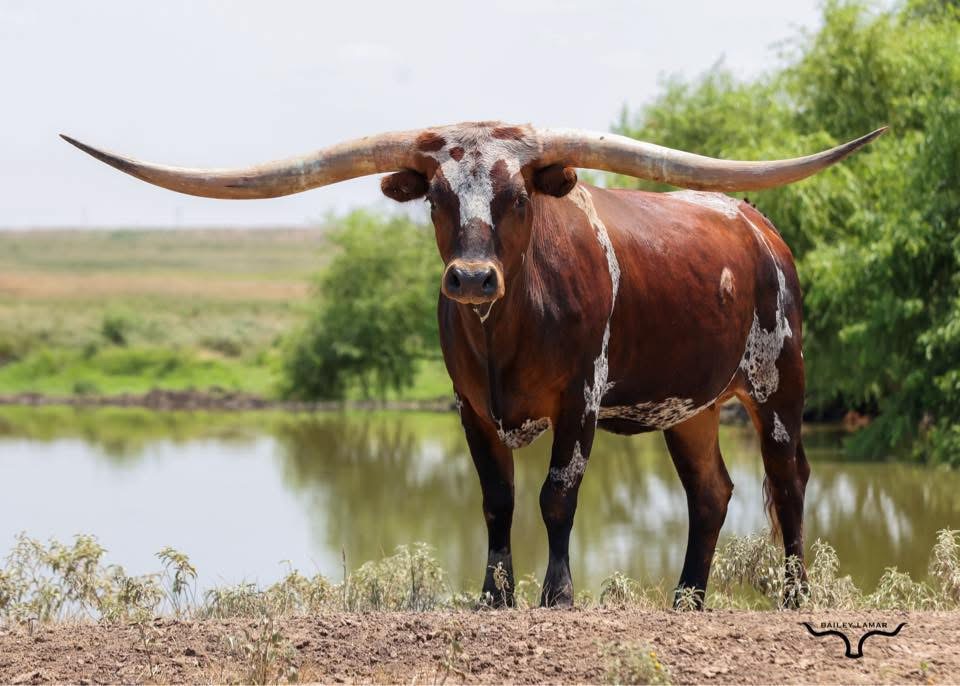
Southwest Oklahoma is not subtle. The wind runs 40 to 50 miles an hour most days, there are not many trees, you can see 40 miles in every direction, and Quartz Mountain sits to the south on the clearest days.
Jordan describes pulling up to the farm in the morning: the first thing you smell is cows and diesel and dirt. The dust that blows through makes for exceptional sunsets because it gives the light something to go through.
It is not for everyone. It is exactly right for Longhorns.
The farm runs on a system that works. 160-acre quarters split between wheat crop and pasture. The cattle graze the wheat while it is young and pulling protein, then move to grass after. Free fertilizer goes back on the wheat. Grandpa checks on the herd twice a day, every day, because for ten or fifteen years he did not have cattle and he is not taking that for granted. He pulled a calf recently, feet first, all by himself, without being asked.
"He caught one that was feet first," Jordan says. "Went and pulled it and hung it and made sure it was good to go. If he hadn't been there, it would have been a little bit of a problem."
What Boutique Actually Means
Flying B Longhorns describes itself as a boutique operation, and Jordan has a specific definition in mind when she uses that word.
"You go to Walmart and every Walmart has the same shirt for sale," she says. "You go to somebody's little boutique on the strip down in Fredericksburg and they make three of those shirts and they're going to be something you've never seen before."
The goal at Flying B is that when someone comes to the farm, every animal in the field makes them stop. Not blend in, stand out. Color, size, and horn. A limited herd where everything is noteworthy.
They are running about 55 head right now and would like to cap it at 50. The ones coded red in Jordan's spreadsheet are the ones nobody is getting. That list keeps growing.
The Herd They Are Building
Several of those red animals came from the first Legacy Sale the Boeltes attended, when the market was down and they bought well. BR Dee Nile was one of them. She is coded red, she is not going anywhere, and she has a calf out of WT Kid Rock that will be the Legacy Spotlight bull for 2027.
Country Song Chex is also red. He is the face of Bull Alley for 2026, an M.C. Hangin' Tuff son born two days after Cool Hand Luke Chex and one day before M7 Irish Luck, and he has already measured 105" TH. His first baby ever sold brought $24,000. Jordan is protecting him the way you protect something you believe is genuinely special: limiting his output, controlling who gets his babies, keeping his name clean.
"We're trying to treat Country Song a whole lot like the Sillers are treating Texaco," she says. "So far Country Song has only had one baby ever sold and she was $24,000. Protecting him means he's ours, we're not going to partner on him, and what's coming to the market is going to be the best of the best."
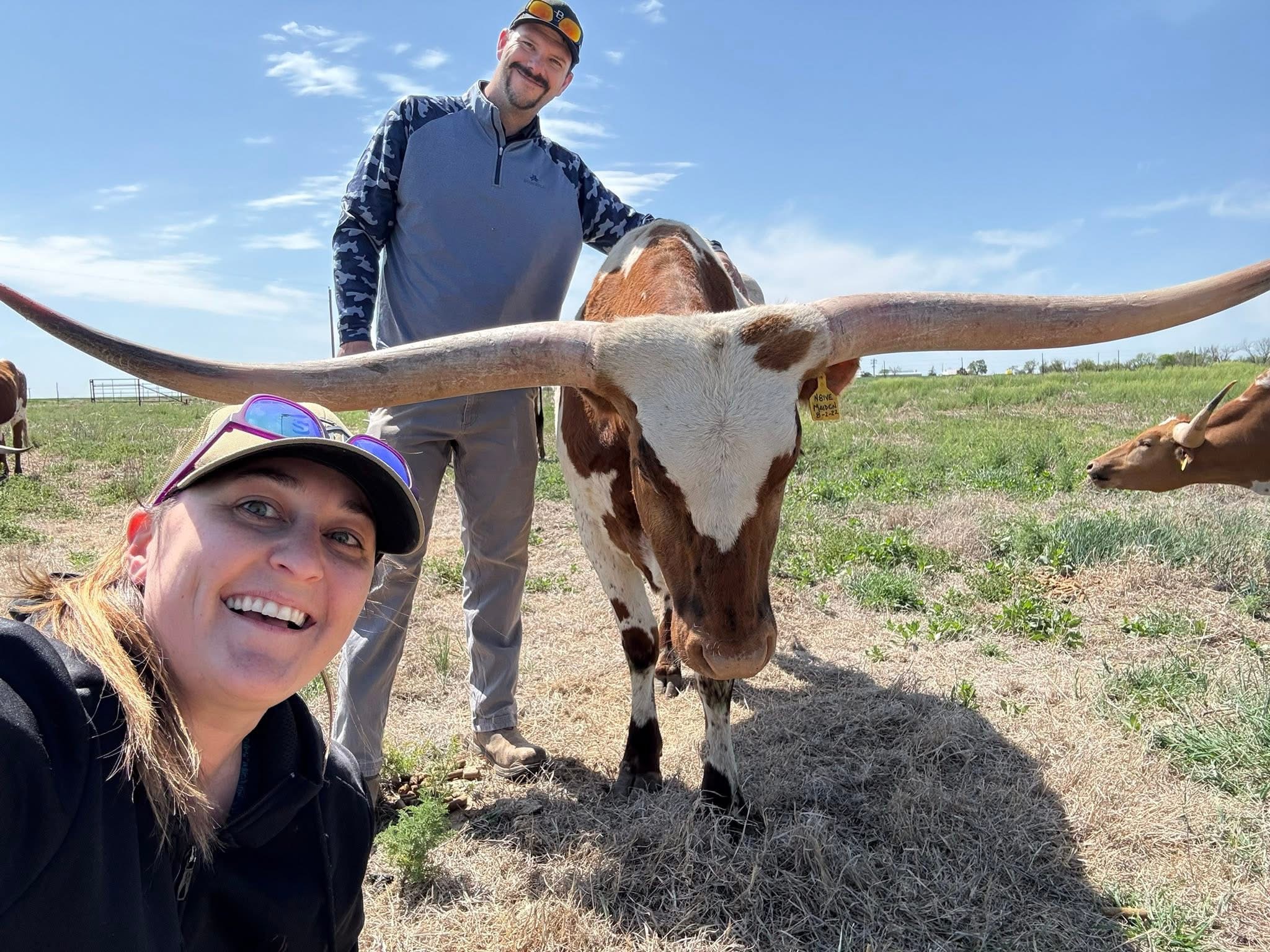
Then there is VooDoo Doll, a M.C. Hangin' Tuff daughter out of Jest Dragging Iron, who is huge and colorful. N8ive Maiden, out of N8ive Dreamz from the Hoosier Longhorn program, big and long and so gentle she will load herself onto the trailer if you park it in the field. And Tuff Martina FL, who is Hunter's mother's contribution to the herd, and who hit 100" TTT in November. The first hundred-inch cow at Flying B.
"Mom's contributed," Jordan says.
Randy Murray, Bob Loomis, and Learning the Hard Way
When the Boeltes started, Jordan went looking online for who had M.C. Hangin' Tuff genetics and Randy Murray came up. She called him and they talked for three hours. He told her to go after two to three year olds that had already had a calf. If they are measuring 60" TTT at two, they will be worth having when they are older. He laid out the baseline and then he gave them a cow born on the same day as their first daughter and named her after her.
"That's a nod to the incredible Longhorn community," Jordan says. "That somebody will do that and they haven't even met you."
Bob Loomis was the one who told Jordan, plainly, that Country Song Chex was too thin. She took him to the 2024 Horn Showcase at 1,250 pounds and Loomis let her know. She brought him home and got to work. A year later, Country Song was at 2,000 pounds.
"He was right and that's part of the learning curve," Jordan says. "We have black Angus and they go out and eat grass. The Longhorns, we were like, you have to feed them. That was a big learning curve."
Running It Like a Business, Sort Of
Hunter and Jordan are not short on things to do. Between them they run a fiber consulting and construction company, a breakfast restaurant, a family office, a flight school lease, river cabins, and as of May of this year, over 4,000 acres of farmland. The Longhorns are not the only thing going on.
Jordan runs the cattle side the same way she runs everything else: if it is going to get done right, she is going to do it herself. She maintains the TLBAA horn database and the Flying B website, tracks every animal in her spreadsheets, and is on-site for anything that matters.
The futurities are a separate calculation. Flying B's focus is built for the sale ring, not necessarily the show ring, and Jordan is clear-eyed about the difference. But she goes anyway, because showing an animal you are about to sell is still the best marketing available.
"We know a lot of our cows may not do well at the futurities," she says. "But we're still going to go and show them off. If we're going to sell one in the same year, we want to show it off as much as possible."
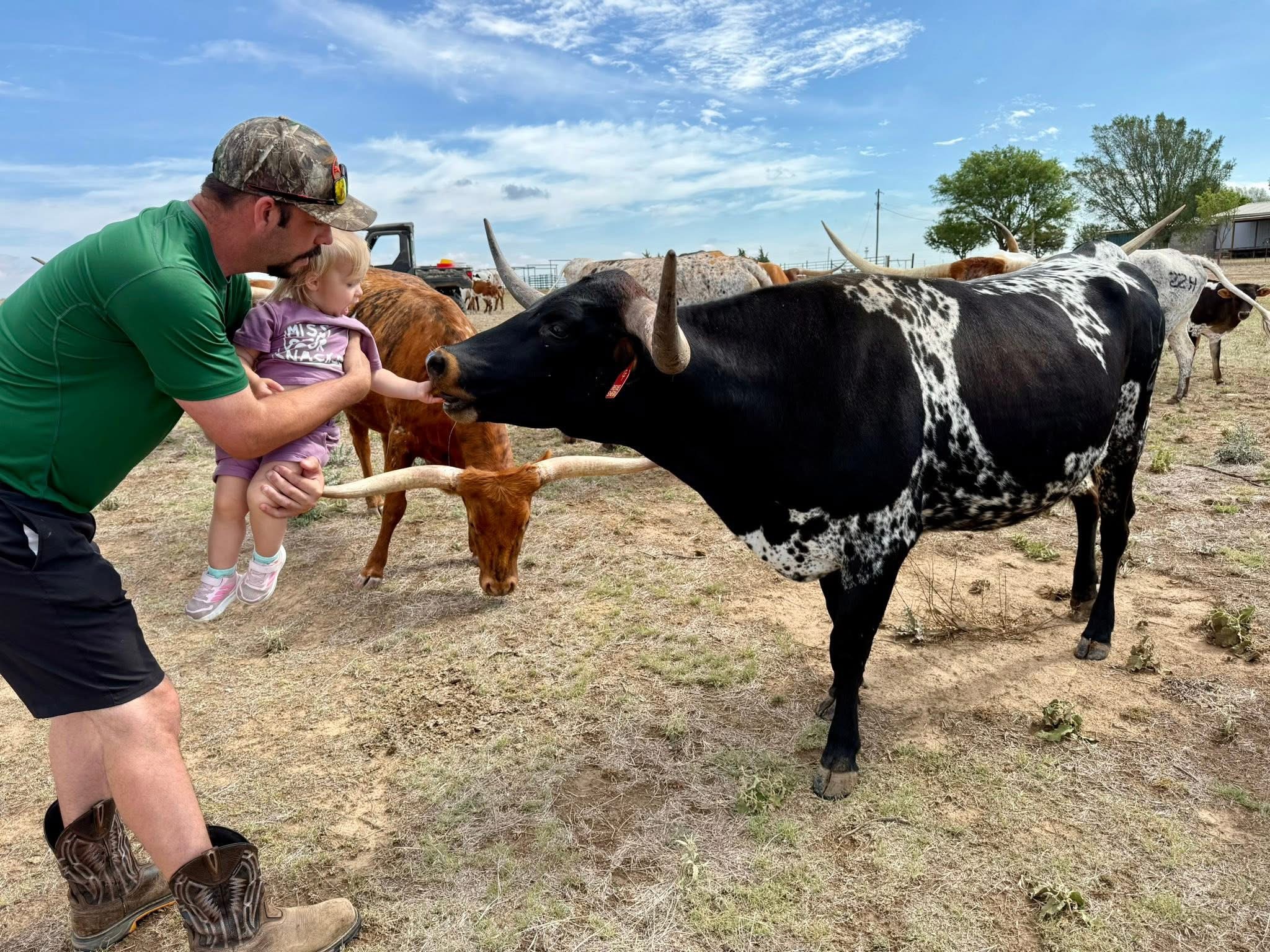
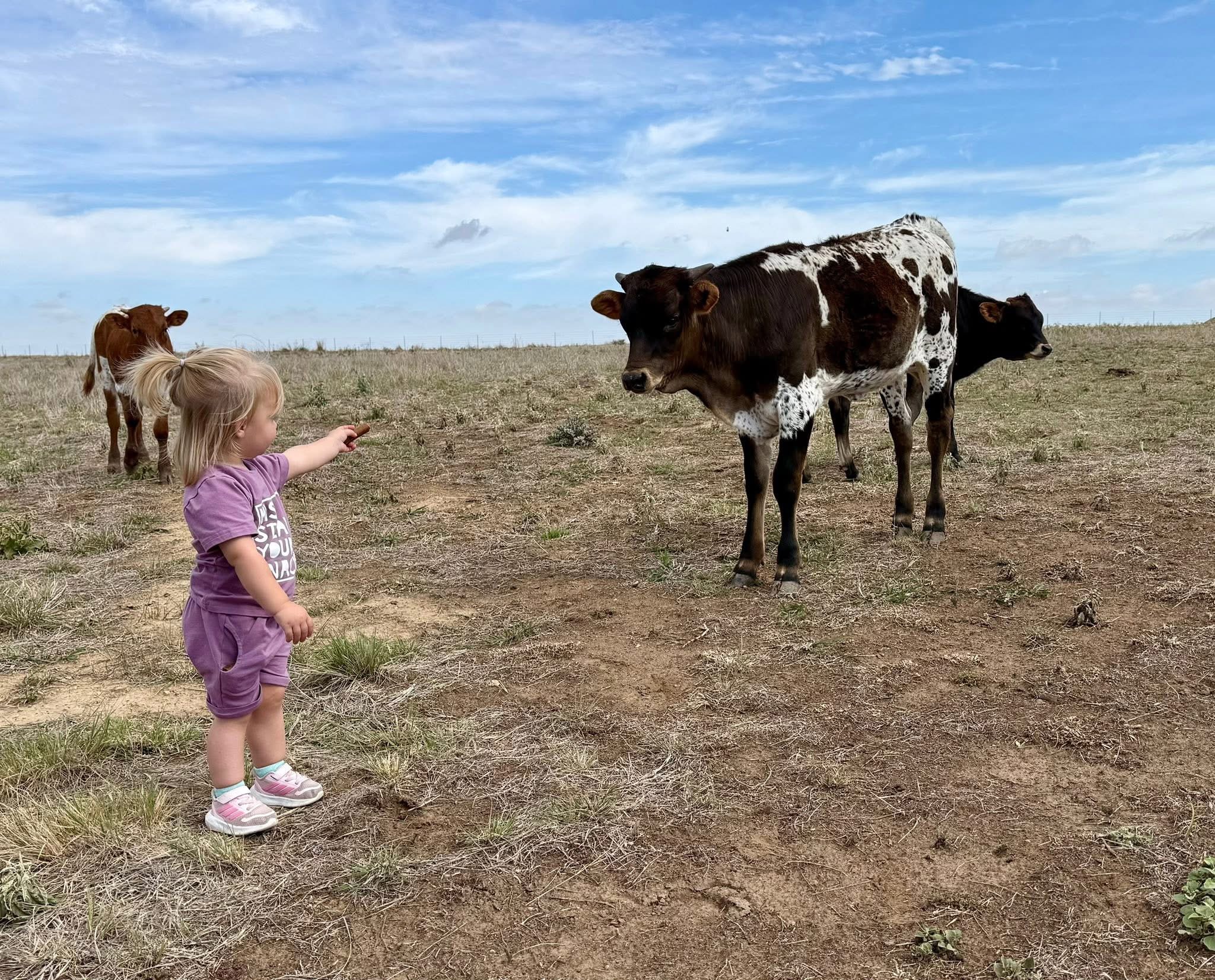
Her two-year-old daughter Hunter goes to the sales with a bucket of cubes and works her way down every row trying to hand feed every animal she can reach. She has not missed a chance yet.
Jordan updates the measurements herself. When a new number goes up on the Flying B Hired Hand website, her phone is not quiet for long. Find Flying B Longhorns at www.flyingblonghorns.com.
This article was written based on a podcast interview on From the Pasture with Hired Hand. Listen to the full episode wherever you get your podcasts, or learn more about breeder websites at hiredhandsoftware.com.